2018年6月5日(周二)下午三點(diǎn),擔(dān)任美國阿拉巴馬大學(xué)英語系應(yīng)用語言學(xué)和 TESOL課程的教授和協(xié)調(diào)人劉迪麟老師在人文逸夫樓A2014學(xué)術(shù)報告廳為我院師生做了題為“Conducting Language Research by Combining Cognitive and Corpus Linguistic Approaches”的學(xué)術(shù)講座。外國語學(xué)院多位骨干教師和英語專業(yè)研究生到場聆聽。
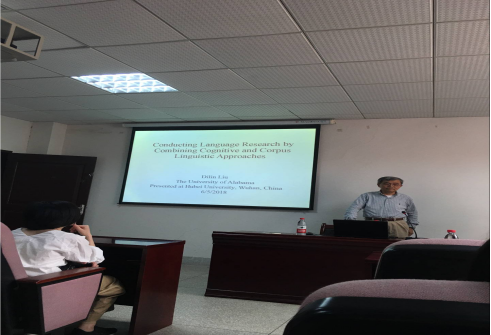
認(rèn)知語言學(xué)是近些年來研究的熱點(diǎn),而語料庫語言學(xué)作為現(xiàn)行語言學(xué)研究的熱門話題,會和認(rèn)知語言學(xué)會有什么聯(lián)系?劉迪麟教授開門見山告訴我們這次講座的目的,就是使認(rèn)知方法和語料庫的方法結(jié)合起來,不僅讓語言研究更具有效度和可信度,還可以讓語言學(xué)習(xí)與教學(xué)更加有效和有趣。
為了使大家更夠更好地理解兩者的關(guān)系,劉迪麟教授首先用各種生動形象的例子梳理了傳統(tǒng)語言學(xué)的重要理論和認(rèn)知語言學(xué)中一些關(guān)鍵理論。在認(rèn)知語言學(xué)中:Language symbolizes our embodied experience.當(dāng)人們基于自己的經(jīng)驗(yàn)構(gòu)建不同的事件時,思維起了非常關(guān)鍵的作用。而語言的結(jié)構(gòu)和使用事實(shí)上都是有依據(jù)的并非任意的。語言的學(xué)習(xí)是在語言使用的基礎(chǔ)之上的。而語言學(xué)習(xí)等同于構(gòu)建學(xué)習(xí)。因此產(chǎn)生了語言構(gòu)建習(xí)得的三種類型:1.Filled constructions.2.Partially-filled constructions.3. Unfilled constructions.
緊接著劉迪麟老師又介紹了也是基于語言使用的語料庫語言學(xué),不僅給語料庫語言學(xué)下了定義,還為大家講述了如何使用語料庫。在使用語料庫時,頻數(shù)是最為重要的。劉迪麟教授談到,認(rèn)知語言學(xué)中如果一個語言詞條如果使用的頻數(shù)很高就變成了象征性的構(gòu)建。認(rèn)知語言學(xué)和語料庫語言學(xué)有三個共同點(diǎn):1.Both approaches are usage-based.2.Both consider meaning central in the study of language.3.Both reject the traditional rigid separation of lexis and grammar as two distinct domains.

整場講座最精彩的地方在于劉迪麟教師基于認(rèn)知語言學(xué)的語料庫語言學(xué)分析。大量的例子都證明了搭配或者是詞組選擇都是有依據(jù)而并非任意的。如,powerful tea and strong car,make an effort and take a bath,come and go等等。在講到意象圖示時,通過路徑來解釋詞組on track.劉迪麟教授還為我們提供了一個新思路:使用語料庫去證實(shí)學(xué)習(xí)語言中出現(xiàn)的錯誤。由于時間關(guān)系,講座在大家不舍中結(jié)束。最后,劉迪麟教授還不忘為大家提供基本參考書目供大家更好的理解此次講學(xué)內(nèi)容。
劉迪麟教授幽默生動的講課方式使得整場講座大家都沉浸在這知識的海洋, 大家欽佩的不僅僅是劉教授的知識廣博,更是老師謙虛的態(tài)度和流利的口語。講座后劉老師雖然離場了,但卻為大家留下了知識的種子,等待著大家去培育出累累碩果。
專家簡介:Dilin Liu is Professor and Coordinator of the Applied Linguistics/TESOL program in the English Department at the University of Alabama, U.S.A. He received his Ph.D. in English from Oklahoma State University. His research and publications focus on grammar and lexis, especially corpus-based description and teaching of grammar and vocabulary; he has also published on other topics, including language and culture, pedagogy, and TESOL teacher education. Liu has been a member of the Editorial Advisory Boards of English Language Teaching Journal (2001-2004), TESOL Quarterly (2005-2008), Reflections on English Language Teaching (2006-2012), and TESOL Journal (2009-), Asian-Pacific Journal of Second and Foreign Language Education (2015-) as well as a reviewer for over twenty applied linguistics journals and publishers, such as Applied Psycholinguistics, Modern Language Journal, Corpora, Corpus Linguistics and Linguistic theory, English for Specific Purposes, Journal of English Linguistics, Journal of Pragmatics, Language and Education, Language Teaching Research, Research in the Teaching of English, System, Cambridge University Press, Palgrave McMillan, and Routledge. He has also been a frequent invited speaker at international conferences and universities in the U.S. and many other countries, such as Cambodia, China, Japan, Singapore, South Korea, and Vietnam.